
 U.S. site →
 Global tax-deductible giving →
Large national audiences
Radio is extremely popular in sub-Saharan Africa, giving media campaigns a huge reach. For example, 59% of women and 70% of men in Uganda tune in at least once a week. [4]
Development Media International runs large-scale media campaigns in low-income countries to create informative and engaging programming that focuses on maternal and child health, nutrition, hygiene and sanitation, sexual reproductive health, and early childhood development.
Their annual demonstrated impact includes:
Donations above A$2 tax-deductible. See our global tax-deductibility options here.
By Card or Paypal
By Bank Transfer, Cheque, Crypto, etc.
Worldwide, 5.3 million children under the age of five die each year. [1] Over half of these deaths could be prevented, and maternal mortality slashed, if families were to make use of simple, inexpensive, or free interventions such as handwashing, giving birth in health facilities, breastfeeding, and making use of readily-available treatments for malaria, pneumonia, and diarrhoea.
Unfortunately, lack of information combined with sociocultural barriers (including reluctance to consult medical professionals) means that preventable deaths continue, particularly in the developing world.
Worldwide, 5.3 million children under the age of five die each year. Over half of these deaths could be prevented with simple interventions.
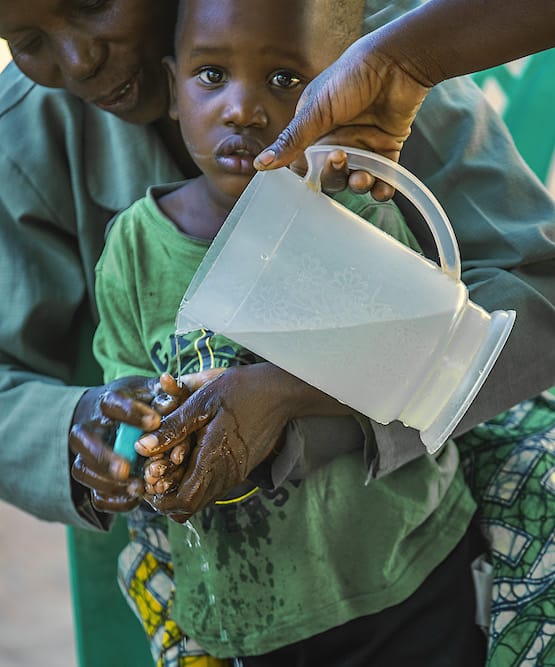
Media health campaigns facilitate information exchange and shifts in cultural norms. Radio, television, and mobile videos can be used to reach millions of people in low-income countries, raising awareness, for example, about how to identify and protect against potentially dangerous illnesses, and what to do if they occur. At the same time, broadcasts can help break down cultural barriers that prevent people from adopting healthy behaviours, persuading vulnerable populations, for instance, to make use of health workers and available resources.
Most poverty aid programs focus on the “supply side” of interventions — for example, training doctors and nurses, supplying equipment and medications, and building healthcare facilities. In contrast, DMI works on the critical but much-neglected “demand side.”
Many of DMI’s campaigns are broadcast on radio in the form of minute-long spots in local languages, written by DMI’s creative teams in Africa with oversight from creative experts in the UK. They run 10 times per day over several months or years. Some campaigns also involve interactive radio programs, which encourage audiences to phone-in and participate in the radio shows.
TV spots, usually one minute in length and featuring local actors, are broadcast at peak times on popular channels to engage large audiences, ideally at a minimum of three times per day. Mobile video campaigns can be shared via peer-to-peer networks through SD cards or Bluetooth, or on social media, depending on the target demographic.
DMI researches local beliefs, attitudes, behaviours, languages, and barriers to behaviour change in order to create customised media spots that encourage communities to make use of the health care services already available to them, as well as promote positive behaviours that do not rely on services.
Delivered at scale, DMI’s campaigns are estimated to cost only A$30 per child. After DMI conducted a major five-year campaign in Burkina Faso, they evaluated its success with the largest-ever randomised controlled trial to measure the impact of media on health behaviours. Results showed that child mortality was reduced by 9.7%, with approximately 3,000 lives saved — suggesting that this approach is among the most cost-effective methods of saving children’s lives. [2]
DMI’s Burkina Faso campaign was the first time mass media had been scientifically proven to change behaviours in a low-income country. DMI has since completed a second randomised control trial on a family planning campaign in Burkina Faso. The results will be published later this year. [3]
The organisation is currently running programs in Burkina Faso, Côte d’Ivoire, Ethiopia, Madagascar, Malawi, Mozambique, Tanzania, Uganda, and Zambia.
We recommend that gifts up to A$1,000 be made online by credit card. If you are giving more than A$1,000, please consider one of these alternatives.
What can you help Development Media International achieve? Enter a donation amount below to find out.
Radio is extremely popular in sub-Saharan Africa, giving media campaigns a huge reach. For example, 59% of women and 70% of men in Uganda tune in at least once a week. [4]
Delivered at scale, DMI’s campaigns are estimated to cost only A$11–A$41 per DALY, or A$297–A$1,146 per life saved, making it one of the most cost-effective health interventions available. These figures have been peer reviewed and published in BMJ Global Health.
DMI’s campaign messaging is pre-tested with local audiences to ensure is is understandable, relevant, persuasive, and engaging. They also conduct post-broadcast feedback research to ensure optimal messaging.
When possible, DMI avoids paying airtime fees by providing on-the-job training and co-producing live programs with their partner radio stations.
DMI has conducted two large-scale randomised control trials (RCT) that have provided gold-standard evidence for their campaigns’ effectiveness. Where RCTs are not possible, DMI uses quasi-experimental designs to evaluate its work.
DMI can educate communities about multiple health issues in a single campaign for little extra cost. DMI has also invested in solar panels for radio stations to avoid program interruptions due to power outages and to strengthen relationships with radio stations.
DMI is recognised as a standout giving opportunity by charity evaluators Giving What We Can and ImpactMatters. [5] [6] [7] [*] ImpactMatters [*] awarded them the highest ratings across-the-board in Impact and Cost, Quality of Evidence, Quality of Monitoring Systems, and Learning and Iteration.
DMI partners with leading international health bodies such as the World Health Organization; Every Woman Every Child; and The Partnership for Maternal, Newborn and Child Health. DMI also collaborates with prestigious universities including London School of Hygiene & Tropical Medicine, University College London, and the Massachusetts Institute of Technology.
All photos and videos courtesy of Development Media International
[1] World Health Organization, Children: reducing mortality fact sheet
[2] DMI, Burkina Faso: Child Survival RCT
[3] DMI, Burkina Faso: Family Planning RCT
[4] Uganda Bureau of Statistics and ICF, Uganda Demographic and Health Survey 2016
[5] Giving What We Can, Charity Update 1: Development Media International
[6] Impact Matters, 2015-2016 Impact Audit of DMI
[7] Example media campaigns can be viewed on DMI’s Youtube channel
[*] ImpactMatters has been one of the charity evaluators we have historically used to inform our recommendations. Impact Matters has subsequently been acquired by Charity Navigator and no longer uses the “Impact Audit” model we used as a basis for our recommendations.
Support Development Media International
Donate