EIDU is a technology-driven not-for-profit education organisation dedicated to addressing the global learning crisis by delivering a comprehensive digital classroom solution that integrates within public education systems. Operating primarily in Kenya and Nigeria, with initial pilots in Rwanda and Pakistan, EIDU provides governments with an open, affordable digital platform that equips classrooms in public schools with low-cost devices preloaded with an offline-capable, adaptive learning curriculum. By combining digital personalised learning (DPL) with structured pedagogy, teacher lesson guides, and automated, anonymised data dashboards for governments, EIDU transforms school monitoring and instruction to ensure children acquire essential foundational literacy and numeracy skills.
Their demonstrated impact includes:
Scaled Reach Across Public Systems: Expanded its operations to serve approximately 790,000 learners across 10,500 public schools by 2025, partnering with 39 county governments in Kenya alongside expanding programs in Nigeria.
Proven Learning Gains: Demonstrated a highly significant overall effect size of 0.5 standard deviations (SD) on early-grade learning outcomes in a rigorous, year-long independent randomised controlled trial (RCT) in Kenya, generating equitable proficiency gains across both literacy and numeracy.
Exceptional, Scalable Cost-Effectiveness: Reduced long-term ongoing program costs to under €5 (A$8.79) per child per year by employing a shared-device model (typically one to three smartphones or tablets per class) rather than an expensive 1-to-1 student-to-device ratio.
Learning poverty refers to a severe global crisis resulting in children unable to read and understand a simple text by age 10. In Sub-Saharan Africa, this challenge affects a staggering 90% of children, encompassing both the 20% who are completely out of school and the 70% who attend school regularly but fail to acquire foundational skills. In Kenya, approximately 74% of primary-age children are not proficient in reading.
Contributing factors include overly ambitious school curricula that do not match students’ actual learning capacities, alongside primary teachers who face isolation, limited specialised training, and a lack of structured instructional support. The failure to establish these foundational core competencies early creates severe long-term consequences; children who fall behind are much more likely to repeat grades, drop out entirely, remain trapped in poverty, and face restricted life opportunities.
This educational crisis disproportionately impacts children from rural, low-income, and marginalised backgrounds, entrenching a systemic failure where education systems deliver formal schooling but not actual learning.
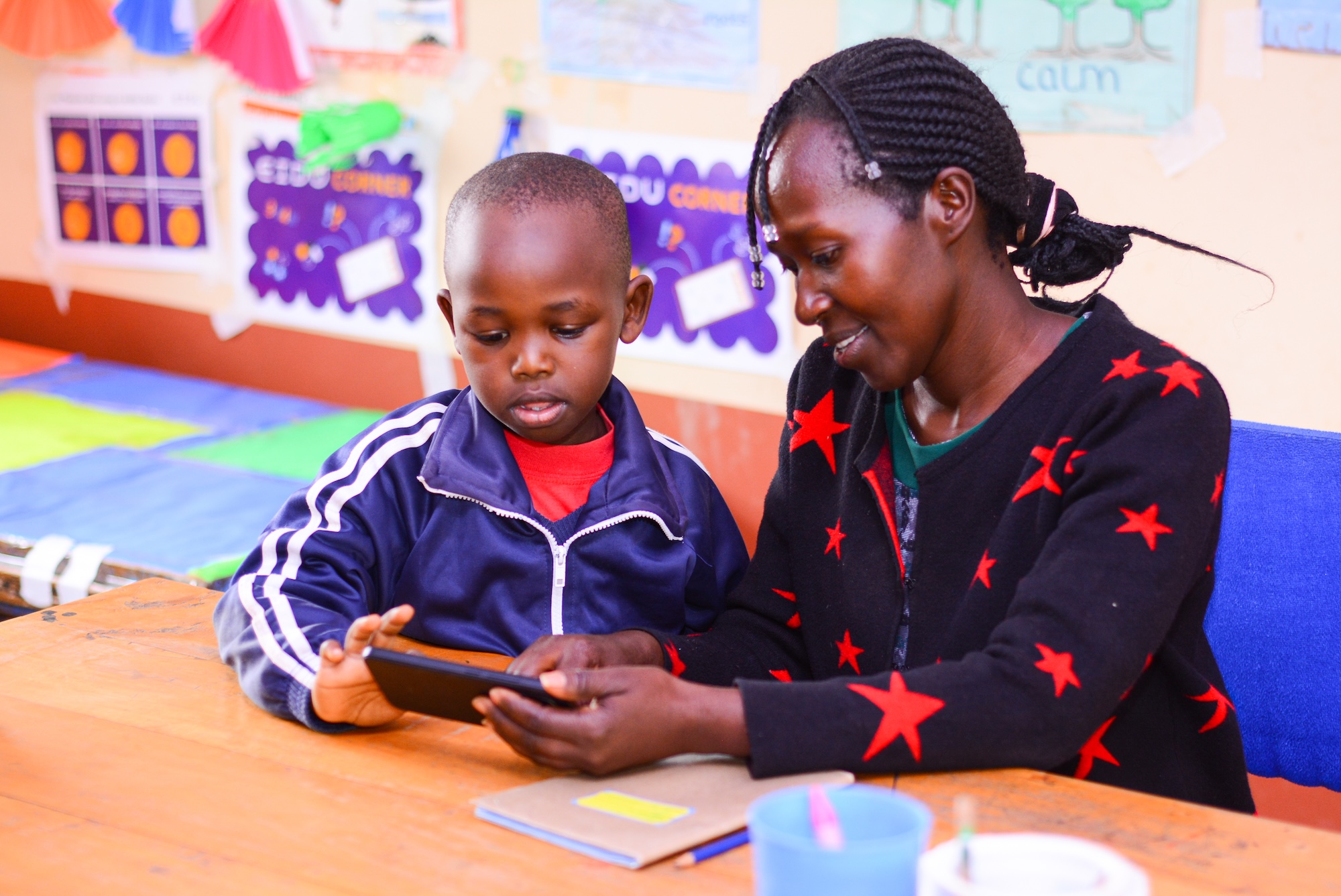
EIDU Kenya, Student using digital device, Murang
The Solution: Government-Led, Technology-Driven Personalised Learning
EIDU tackles these issues by embedding digital technology for learning directly into existing public schools. Recognising that individual 1-to-1 electronic device initiatives are financially unsustainable for low-income public budgets, EIDU equips classrooms with a minimal number of shared Android smartphones or tablets running an entirely offline platform.
The core intervention relies on four key operational pillars:
Adaptive Digital Curriculum: The offline-capable software platform delivers gamified, play-based lessons covering foundational reading fluency, phonics, counting, and arithmetic tailored dynamically to each individual child’s learning speed.
Structured Pedagogical Frameworks: EIDU digitises and embeds established public curricula and proven pedagogical structures (such as Kenya’s government-approved Tayari and Tusome early-years programs) directly into the device interface.
Low-Touch Teacher Enablement: Frontline educators receive simple, scripted, step-by-step lesson plans that easily align with a 20-minute daily digital practice block, reducing administrative preparation burdens.
Actionable Data Dashboards: Student interactions are anonymised, timestamped, and uploaded to central tracking dashboards, providing real-time operational insights to school heads and education ministry officials.
EIDU Nigeria, Teacher with digital device lesson plans, Oyo State
How EIDU works
EIDU functions through a sustainable, phased “government-takeover” delivery architecture designed to transition operations entirely into public infrastructure.
Their work unfolds across clear operational stages:
Institutional Legal MoUs: EIDU initiates programs only after signing formal Memorandums of Understanding (MoUs) with national or sub-national government entities, ensuring the platform is legally integrated into public education plans.
The Shared-Device Rotation Model: Classrooms are supplied with one to three robust Android devices. During regular school hours, teachers assign students to short, rotating 7-minute play-based practice intervals, maintaining a continuous learning cycle without disrupting daily routines.
Cascade Training Delivery: Rather than establishing a parallel network of external trainers, EIDU trains government education officers and local school inspectors to act as “master trainers,” who then cascade the technical and pedagogical coaching down to school-level teachers.
Automated Accountability Loops: Because every student interaction is recorded locally on the device, the platform effectively acts as a built-in, rapid evaluation. When devices sync, analytics populate government dashboards, allowing supervisors to automatically flag low-use schools and intentionally target physical support visits where they are needed most.
EIDU Nigeria, Student with digital device in Corner Adamawa State
790,000
Learners reached in Kenya in 2025.
7 LAYS
Learning-Adjusted Years of Schooling generated per A$152 spent.
A$8.79
Long-term ongoing program costs per child per year of their shared-device model.
Other ways to donate
We recommend that gifts up to A$1,000 be made online by credit card. If you are giving more than A$1,000, please consider one of these alternatives.
What can you help EIDU achieve? Enter a donation amount below to find out.
AUD
What makes EIDU so effective
Rigorous Evidence Base
Global bodies like the Global Education Evidence Advisory Panel (GEEAP) categorise structured pedagogy and targeted instruction as education “Smart Buys.” EIDU’s model is heavily validated by a year-long independent RCT conducted across 291 public pre-primary schools in Murang’a County, Kenya. The study confirmed a substantial learning impact of 0.534 standard deviations, proving that integrating technology into public school structures creates highly equitable, system-wide academic improvement across varying class sizes and baseline student aptitudes.
Deep Systems Alignment and Local Ownership
EIDU builds directly on existing national structures, such as Kenya’s Tusome literacy curriculum reforms, and collaborates with public curriculum development centres to ensure legal alignment. Furthermore, 80% of EIDU’s personnel live and work natively within its beneficiary countries, generating strong local institutional buy-in and contextual relevance.
A Comprehensive, Low-Cost Platform Design
The EIDU platform supports all key actors in the education system through a single tool, giving learners personalised learning pathways, teachers structured lesson plans and real-time classroom analytics, and government officials system-wide assessment dashboards. It runs with as little as one device per classroom, integrates into existing government data systems (EMIS), and uses AI to personalise content while keeping teaching human-led.
Recognition for EIDU
EIDU’s work has received external recognition through peer-reviewed research, sector publications, and partnerships with public education systems. Its model has been studied by independent education researchers and featured in external analysis on technology-supported personalised learning in low- and middle-income countries.
EIDU has also been adopted through formal government partnerships, including with the national and county governments in Kenya, and state governments in Nigeria, reflecting growing institutional confidence in its approach.
SourcesExpand ListCollapse List
Global Education Evidence Advisory Panel. (2020, October). Cost-effective approaches to improve global learning: What does recent evidence tell us are “smart buys” for improving learning in low- and middle-income countries? World Bank.

 U.S. site →
 Global tax-deductible giving →