Youth Impact helps children who have fallen behind in school catch up quickly, so they can build the foundational reading and maths skills they will need for the rest of their lives. Working with governments and communities, Youth Impact trains teachers to use programs focused on targeted educational instruction, a simple, proven approach that groups children by their current learning level, rather than by age or grade.
With government partnerships in Botswana, Namibia, South Africa, India, and the Philippines, and nearly 100 iterative A/B tests conducted to date, Youth Impact embeds cost-effective learning programs such as Teaching at the Right Level (TaRL) in public education systems at a low marginal cost of approximately A$16.68 per child per year, so more children can thrive now and in the future.
Their demonstrated impact includes:
Rapid Scale and Reach: As of 2026, reached over 1 million beneficiaries across all its programs in Botswana, Namibia, South Africa, India, and the Philippines.
National System Integration: Successfully embedded the TaRL pedagogy within the public school timetables of every government primary school across all regions of Botswana.
Indian State Expansion: Secured a formal, government-financed statewide technical agreement in 2025 with the Government of Karnataka to implement Ganitha Ganaka (the local iteration of their program), positioned to scale programming to 1.2 million children across 38,000 schools.
Low-Tech Crisis Resiliency: Achieved a 65% increase in students mastering division during pandemic-related school closures by rapidly pivoting to low-tech, phone- and SMS-based TaRL instruction.
The Problem: Widespread Learning Poverty in Sub-Saharan Africa
Learning poverty refers to a severe global crisis resulting in children unable to read and understand a simple text by age 10. In Sub-Saharan Africa, this challenge affects a staggering 90% of children, encompassing both the 20% who are completely out of school and the 70% who attend school regularly but fail to acquire foundational skills. In Uganda, approximately 82% of late primary-age children are not proficient in reading.
Contributing factors include overly ambitious school curricula that do not match students’ actual learning capacities, alongside primary teachers who face isolation, limited specialised training, and a lack of structured instructional support. The failure to establish these foundational core competencies early creates severe long-term consequences; children who fall behind are much more likely to repeat grades, drop out entirely, remain trapped in poverty, and face restricted life opportunities. This educational crisis disproportionately impacts children from rural, low-income, and marginalised backgrounds, entrenching a systemic failure where education systems deliver formal schooling but not actual learning.
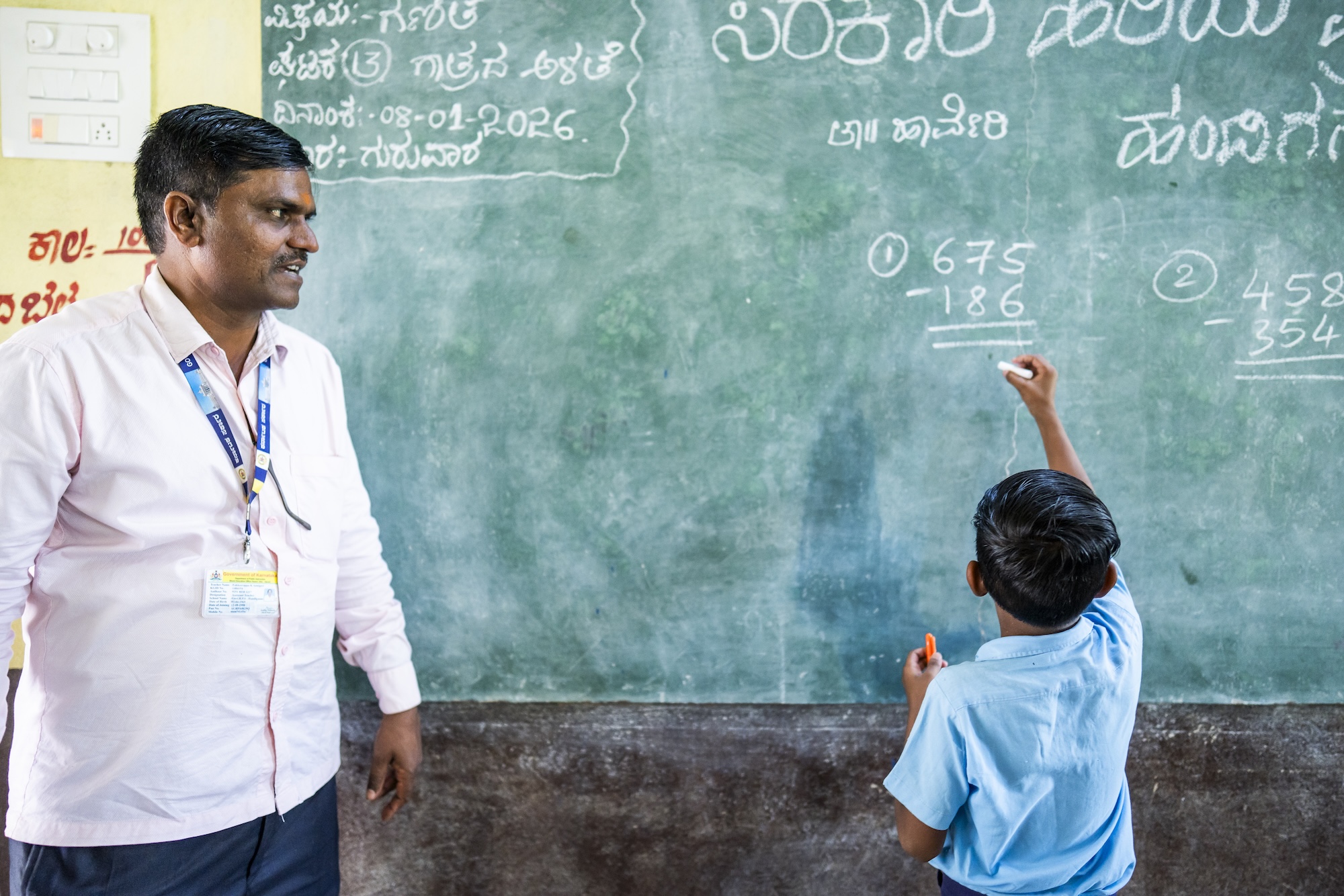
9 years old Dhanush, a grade 4 student, answers a question while 49 years old S F Kamadod, a teacher, conducts a classroom session on mathematics at a Govt. primary school in Haveri, Karnataka, India, January 2026.
The Solution: Government-Led, Level-Appropriate Learning
Youth Impact combats this learning crisis by implementing targeted instruction approaches, such as the Teaching at the Right Level (TaRL) pedagogy. Grounded in decades of robust global evidence, TaRL discards rigid age- and grade-based tracking to tailor instruction directly to a child’s actual learning level rather than their grade. The organisation operates under a dual structure that combines government-led scale with a focused direct delivery hub, partnering strategically with ministries of education to integrate the approach within public systems. By training government teachers and recruiting local youth, Youth Impact establishes a system-wide model that guarantees measurable learning gains while transitioning long-term execution directly into national education structures for sustainability.
Youth Impact tackles the issue at its roots by focusing on the following key activities:
Implementing a structured TaRL curriculum and user-friendly teaching and learning materials to systematically improve foundational maths and reading competencies.
Training and coaching government teachers to build capacity in assessing learners, grouping them by ability, and delivering engaging instruction.
Securing a dedicated daily one-hour remediation slot within public school timetables allocated by the government.
Embedding robust child safeguarding policies and accessible reporting mechanisms across all operations to protect children, promote student agency, and preserve beneficiary dignity.
Government-Led Scale and Innovation Hub: Youth Impact scales primarily with governments and through public education systems, signing multi-year MOUs and leveraging substantial in-kind government resources. Simultaneously, it maintains a small direct delivery site to spark adoption, support early implementation, and run rigorous, ongoing experimentation (such as rapid A/B tests) to drive continuous operational improvement and innovation.
Teacher Training and Timetable Integration: At the school level, Youth Impact partners directly with ministries of education to embed TaRL into the regular school timetable via a dedicated daily one-hour remediation slot. Teachers and school staff receive comprehensive training and ongoing coaching to deliver the approach effectively.
Student Assessment and Leveling: Before instructional delivery begins, teachers administer simple assessment tools for literacy and numeracy to map each child’s starting learning level. Rather than traditional grade lines, children are grouped into smaller cohorts based entirely on their assessed ability.
Targeted and Engaging Instruction: Facilitators deliver fun, highly interactive, and learner-centred sessions. Using contextually adapted, right-level foundational teaching and learning materials, they focus intensely on building core micro-competencies in reading and mathematics.
Formative Feedback with the Checkpoint Tool: Throughout and at the close of TaRL sessions, educators use the Checkpoint tool to gather quick, formative feedback on children’s mastery of session content. This real-time data allows teachers to plan, pace, and adjust targeted instruction dynamically to inform lesson delivery.
Government Integration for Systemic Scale: Viewing the state as the ultimate vehicle for scale, Youth Impact supports government teams to assume full operational ownership of the intervention. Government teams chair regional TaRL committees, oversee data reporting systems, coordinate rollouts, and lead quality assurance, embedding the program fully within sustainable government structures.
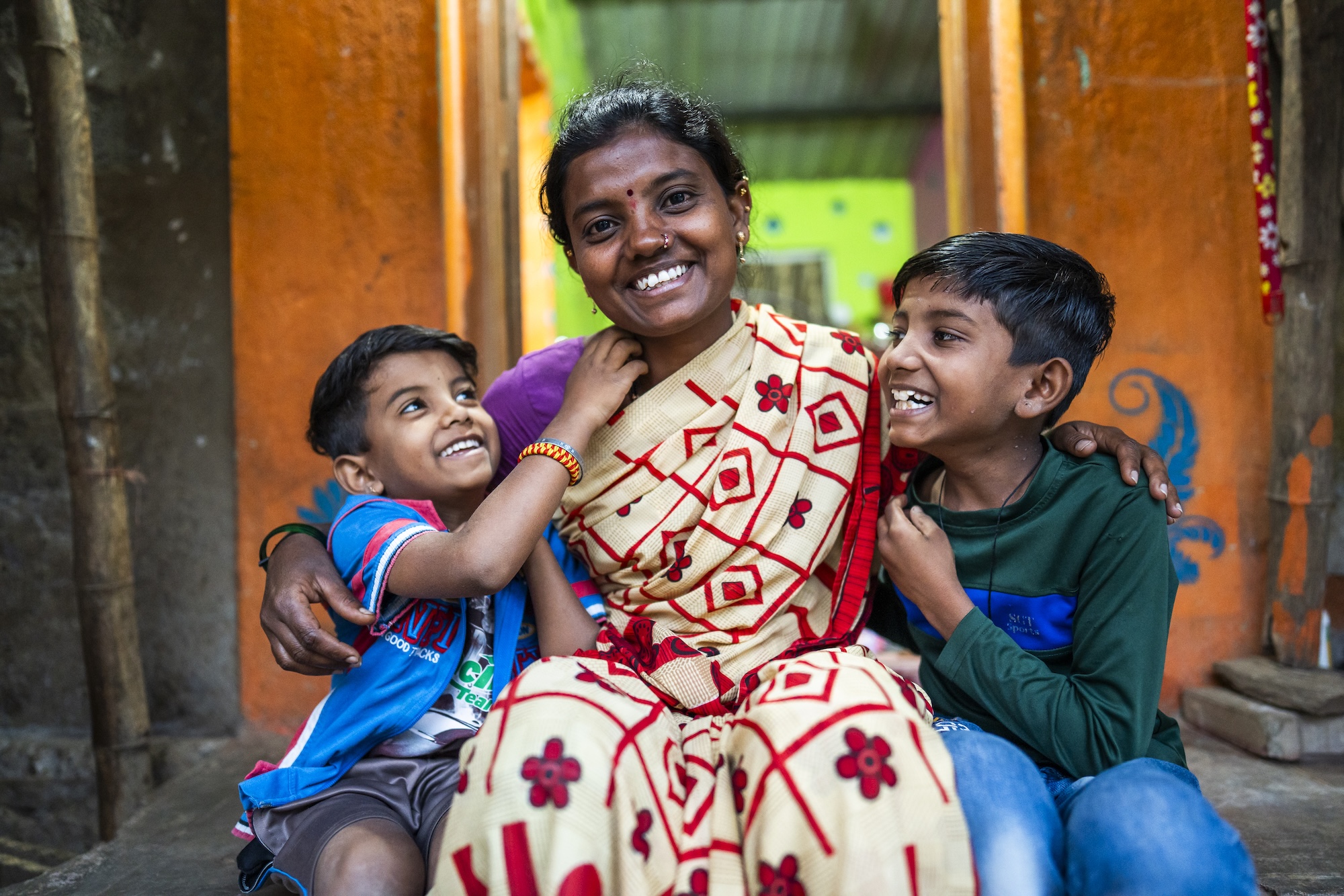
Shaila Durgappanigalur, mother of 9 years old Dhanush, reacts as she sits with her children at her house in Haveri, Karnataka, India, January 2026.
355,000
Beneficiaries reached with foundational programming in 2025.
7
Learning-Adjusted Years of Schooling (LAYS) generated per A$152 spent.
400-500
Field staff mobilised across communities.
Other ways to donate
We recommend that gifts up to A$1,000 be made online by credit card. If you are giving more than A$1,000, please consider one of these alternatives.
What can you help Youth Impact achieve? Enter a donation amount below to find out.
AUD
What makes Youth Impact so effective
Proven results
Youth Impact has scaled significantly since its founding in 2014, expanding its footprint across five countries—Botswana, Namibia, South Africa, India, and the Philippines. In Botswana, the program has grown from a one-school pilot to every government primary school in the country by the end of 2026. Today, the organisation reaches approximately 300,000 children annually, delivering high impact at a low marginal cost of approximately A$16.68 per child per year.
Evidence
Youth Impact’s model is backed by an outstanding global evidence base, including decades of research, nearly 100 A/B test trials, and multiple randomised controlled trials (RCTs) that confirm its effectiveness. In 2021–2022, Youth Impact participated in a rigorous five-country RCT to evaluate low-tech interventions in stemming learning loss. The trial offered compelling evidence: less than three hours of 1:1 targeted tutoring delivered over the phone by community volunteers across an eight-week period yielded massive learning gains equivalent to 0.891 standard deviations and 1.1 Learning-Adjusted Years of Schooling (LAYS).
Data for impact
Using impact data as a strategic anchor for constant improvement, Youth Impact maintains a deep organisational commitment to data-driven operational enhancement. The organisation utilises a structured internal cost-effectiveness framework to systematically optimise student learning gains. This framework tracks performance via a dedicated dashboard that identifies major cost drivers, summarises insights from past trials, and conducts test-by-test cost and outcome analyses linked to transparent unit costs. By applying a clear, rigorous decision rule—Drop, Adopt, Repeat—Youth Impact ensures that only highly cost-effective modifications and innovations are integrated into its standard program delivery.
Recognition for Youth Impact
Youth Impact was named a recipient of the 2022 Klaus J. Jacobs Best Practice Prize, honouring outstanding achievement and practice in advancing quality education.
Youth Impact received the UBS Optimus Foundation COVID-19 Relief Prize, awarded for demonstrating rigorous evidence of sustained learning outcomes through a COVID-19 education intervention.
Youth Impact was named a top-100 innovation in theHundrED Global Collection 2026, an annual list of the world’s most impactful and scalable education innovations.
Youth Impact’s co-founders were featured on Vox’s Future Perfect 50 list, recognising people working to transform the world for the better.
Youth Impact co-founder Moitshepi Matsheng was selected for Obama Leaders: Africa (2019), connecting emerging leaders across the continent.
Youth Impact’s work was featured in The New York Times, in an opinion piece on remote learning and families during the pandemic.
Youth Impact’s research was published in Nature Human Behaviour, a randomised controlled trial evaluating low-tech phone-based tutoring in Botswana during COVID-19.
SourcesExpand ListCollapse List
Angrist, N., Evans, D. K., Filmer, D., Glennerster, R., Rogers, H., & Sabarwal, S. (2025). How to improve education outcomes most efficiently? A review of the evidence using a unified metric. Journal of Development Economics, 172, 103382.
Angrist, N., & Meager, R. (2023). Implementation matters: Generalising treatment effects in education (Working Paper No. 2023/001). What Works Hub for Global Education.
Angrist, N., Ainomugisha, M., Bathena, S. P., Bergman, P., Crossley, C., Cullen, C., … & Sullivan, T. (2025). Building resilient education systems: Evidence from large-scale randomised trials in five countries (No. w31208). National Bureau of Economic Research.

 U.S. site →
 Global tax-deductible giving →